Product
News
- Can Hydraulic Breakers Be Shipped to Iran Normally? Shipping, Customs & Payment Risk Guide
- Hydraulic Breaker Customer Demands a Price Reduction Before Delivery? How Should Suppliers Handle Contract Price Negotiations?
- Pakistan, Afghanistan, Kazakhstan Buyers Notice: Professional Hydraulic Breaker OEM Factory, Strictly Follow Soosan Technical Standards
- Special Offer Hydraulic Breaker Chisels for Middle East Market | Zhengzhou Hanyun Factory Wholesale for Saudi, Egypt, Turkey
- Why do the UAE, Oman, and Morocco prefer the Soosan SB series hydraulic breakers over the Furukawa HB series?
- Iran Post-war Reconstruction Boom | High Demand for Excavators & Hydraulic Breakers | Zhengzhou Hanyun Factory Supply
contacts
Contacts:Jacky Zhang
Phone:+8618937103255
Email:hanyunpsq@gmail.com
Address:No. 167, Xuchang Road, Shangjie District, Zhengzhou City
Knowledge
GCr15 vs 42CrMo — Which Steel Is Better for Hydraulic Breaker Pistons?
The performance of a hydraulic breaker piston depends mainly on its ability to withstand alternating pressure and impact load. These two forces act continuously during operation — the piston moves rapidly inside the cylinder, striking the chisel thousands of times per minute. To survive under such extreme stress, both material selection and heat‑treatment precision are crucial.
From more than 20 years of manufacturing experience, we’ve found clear material characteristics when comparing GCr15 and 42CrMo steels.
1️⃣ Microstructure and Grain Control
GCr15, a high‑carbon chromium bearing steel, has fine grains and a uniform crystalline orientation. After proper heat treatment, it achieves a high surface hardness (HRC 60 ± 2) with excellent wear resistance and minimal deformation. This microstructure is ideal for pistons that operate under repeated friction and compression.
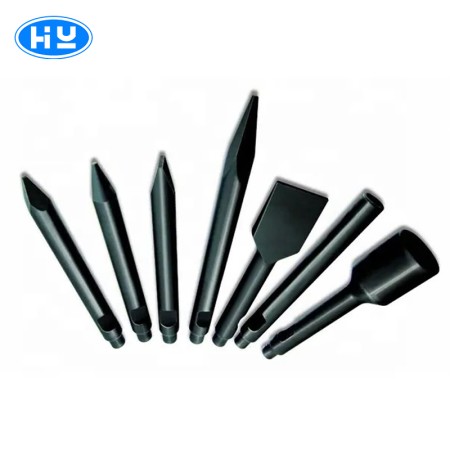
By contrast, 42CrMo — a chromium‑molybdenum alloy steel — exhibits superior toughness and ductility, making it highly resistant to bending or fracture. These properties are essential for chisel production, since chisels not only endure direct impact but also prying and twisting forces in the field.

GCr15 vs 42CrMo — Which Steel Is Better for Hydraulic Breaker Pistons
2️⃣ Hardness Gradient after Heat Treatment
An effective piston must have a controlled hardness gradient — a harder surface to resist wear, and a slightly softer core to absorb impact energy. GCr15 responds exceptionally well to controlled quenching, achieving a smooth transition from surface to core hardness, while maintaining dimensional stability.
3️⃣ Real‑World Performance
In field applications, GCr15‑based pistons show longer service life and consistent striking performance, especially in high‑frequency breakers. In contrast, 42CrMo’s ductility, though beneficial for chisels, may lead to faster wear in the piston’s sliding area.
Conclusion — Material Optimization for Each Component
Based on technical data and production results:
- GCr15 is better suited for hydraulic breaker pistons, where hardness and wear resistance are critical.
- 42CrMo is more appropriate for chisels, which require superior toughness and flexibility.
In modern hydraulic breaker manufacturing, understanding this balance allows engineers to design components that maximize efficiency, durability, and safety — ensuring every impact delivers power without compromise.