Product
News
- Hydraulic Breaker Manufacturer in China | Furukawa HB15G HB20G HB30G HB40G & SOOSAN SB Series OEM Factory
- Can Hydraulic Breakers Be Shipped to Iran Normally? Shipping, Customs & Payment Risk Guide
- Hydraulic Breaker Customer Demands a Price Reduction Before Delivery? How Should Suppliers Handle Contract Price Negotiations?
- Pakistan, Afghanistan, Kazakhstan Buyers Notice: Professional Hydraulic Breaker OEM Factory, Strictly Follow Soosan Technical Standards
- Special Offer Hydraulic Breaker Chisels for Middle East Market | Zhengzhou Hanyun Factory Wholesale for Saudi, Egypt, Turkey
- Why do the UAE, Oman, and Morocco prefer the Soosan SB series hydraulic breakers over the Furukawa HB series?
contacts
Contacts:Jacky Zhang
Phone:+8618937103255
Email:hanyunpsq@gmail.com
Address:No. 167, Xuchang Road, Shangjie District, Zhengzhou City
Knowledge
What Is the Difference Between a Hydraulic Breaker Flat Pin With a Hole and Without a Hole?
When it comes to hydraulic breaker spare parts, the flat retaining pin is a small but important component. Many customers notice that some hydraulic breakers use a flat pin with a hole, while others use a flat pin without a hole.
So, what is the difference between these two designs? Which type is more durable and reliable?
In this article, we will explain the structure, function, durability, and practical differences between a hydraulic breaker flat pin with a hole and a flat pin without a hole.
What Is a Flat Pin in a Hydraulic Breaker?
The flat pin is an important retaining component inside a hydraulic breaker. It works together with the round pins and the lower cylinder to help hold the hydraulic breaker chisel securely in position.
During operation, the chisel is subjected to repeated high-frequency impact forces. Therefore, the design, material, hardness, and fit of the flat pin can affect the overall reliability and service life of the breaker.
Different hydraulic breaker models may use different flat pin designs depending on the internal structure of the lower cylinder and chisel.
Hydraulic Breaker Flat Pin With a Hole
A flat retaining pin with a hole normally has a relatively complete structure and a larger effective contact area with the lower cylinder and chisel.
Because the impact force can be distributed over a larger contact area, the pressure at a specific point can theoretically be reduced. This can help reduce excessive local stress and improve the durability of the flat pin during long-term operation.
Another important advantage is the retaining structure.
If one of the round pins becomes loose or falls out during operation, the other round pin may still help retain the flat pin for a short period of time. This can reduce the risk of the flat pin immediately falling out and allowing the chisel to directly contact the lower cylinder.
This is particularly important because direct metal-to-metal impact between the chisel and lower cylinder can cause serious damage.
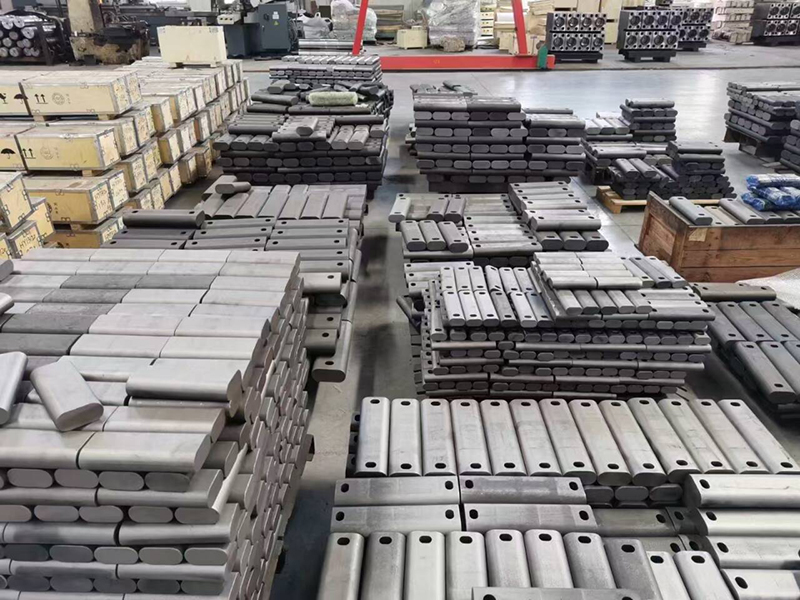
What Is the Difference Between a Hydraulic Breaker Flat Pin With a Hole and Without a Hole?
Hydraulic Breaker Flat Pin Without a Hole
A flat retaining pin without a hole has a different structural design. Depending on the hydraulic breaker model, its effective contact area and retaining method may be smaller or different from those of a flat pin with a hole.
From a mechanical perspective, a smaller contact area can result in higher local pressure under repeated impact loads. Therefore, under the same working conditions, the design may be more sensitive to excessive impact stress, poor lubrication, improper excavator matching, or incorrect operation.
However, it would be incorrect to simply conclude that a flat pin without a hole is always inferior.
The actual service life of a hydraulic breaker flat pin depends on many factors, including the material, heat treatment, machining accuracy, breaker design, chisel quality, working pressure, impact frequency, excavator matching, lubrication, and operator habits.
What Happens If a Round Pin Falls Out?
One of the most practical differences between the two designs is what happens when a round retaining pin becomes loose or falls out.
For some hydraulic breaker designs using a flat pin without a hole, once the retaining round pin is lost, the flat pin may have a greater risk of moving or falling out.
If the flat pin falls out, the hydraulic breaker chisel may move excessively and potentially come into direct contact with the lower cylinder. This can cause serious wear or damage to important breaker components.
For a flat pin with a hole and a suitable retaining structure, the remaining round pin may continue to hold the flat pin temporarily if one round pin is lost.
This does not mean the breaker can continue operating normally. If a retaining pin is missing, the breaker should be stopped and inspected as soon as possible.
Which Hydraulic Breaker Flat Pin Is More Durable?
There is no universal answer that a flat pin with a hole is always more durable than a flat pin without a hole.
For a hydraulic breaker, durability is determined by the entire system rather than one individual component.
Important factors include:
-
Flat pin material and heat treatment
-
Chisel material and hardness
-
Lower cylinder design
-
Machining accuracy
-
Contact area between components
-
Hydraulic breaker working pressure
-
Impact frequency
-
Excavator and breaker matching
-
Lubrication and maintenance
-
Operator working habits
-
Working conditions
For example, even a high-quality flat retaining pin can wear prematurely if the breaker is incorrectly matched with the excavator, operated at excessive pressure, or used without sufficient lubrication.
How to Choose the Right Flat Pin for a Hydraulic Breaker?
When purchasing hydraulic breaker spare parts, the most important thing is to select the correct part according to the specific breaker model and internal structure.
Customers should normally confirm:
-
Hydraulic breaker brand and model
-
Chisel diameter
-
Flat pin dimensions
-
Round pin dimensions
-
Lower cylinder structure
-
Original spare part specifications
For example, different SOOSAN SB series and Furukawa HB series hydraulic breakers may use different retaining structures and component dimensions.
Therefore, simply purchasing a flat pin based only on its appearance is not recommended.
Conclusion
The main difference between a hydraulic breaker flat pin with a hole and a flat pin without a hole is their structural design, contact area, and retaining method.
A flat pin with a hole may provide a larger effective contact area and, in some designs, better protection against the flat pin immediately falling out if one round pin is lost.
However, the durability of a hydraulic breaker does not depend on the flat pin alone. Chisel quality, heat treatment, machining accuracy, hydraulic pressure, excavator matching, lubrication, and working conditions all play important roles.
For this reason, the correct approach is to choose the flat retaining pin according to the specific hydraulic breaker model and original design, rather than simply assuming that one type is better than the other.
If you are looking for hydraulic breaker spare parts, including flat pins, round pins, chisels, bushings, pistons, and other breaker components, providing the breaker model and part dimensions can help ensure the correct fit.